

Which Events Helped Draw People To Support Adolf Hitler's Nazi Party?
Skip to Main Content of WWII
How Did Hitler Happen?
Adolf Hitler was appointed chancellor of Deutschland in 1933 following a serial of electoral victories past the Nazi Party. He ruled absolutely until his death by suicide in April 1945.

Adolf Hitler's Rise to Power
Adolf Hitler (April 20, 1889 - April 30, 1945) was appointed chancellor of Frg in 1933 post-obit a series of electoral victories by the Nazi Party. He ruled admittedly until his death by suicide in April 1945. Upon achieving power, Hitler smashed the nation's democratic institutions and transformed Germany into a state of war state intent on conquering Europe for the do good of the and so-chosen Aryan race. His invasion of Poland on September 1, 1939, triggered the European phase of Globe War II. During the course of the war, Nazi military forces rounded upwardly and executed 11 million victims they deemed inferior or undesirable—"life unworthy of life"—amidst them Jews, Slavs, homosexuals, and Jehovah's Witnesses.
Hitler had supreme authority equally führer (leader or guide), but could non have risen to power or committed such atrocities on his own. He had the active support of the powerful German officer form and of millions of everyday citizens who voted for the National Socialist German Workers' (Nazi) Party and hailed him every bit a national savior in gigantic stadium rallies.
How were Hitler and the Nazis possible? How did such odious characters take and hold ability in a land that was a world pacesetter in literature, art, architecture, and science, a nation that had a democratic regime and a costless printing in the 1920s?
Hitler rose to power through the Nazi Party, an system he forged subsequently returning as a wounded veteran from the annihilating trench warfare of World War I. He and other patriotic Germans were outraged and humiliated past the harsh terms of the Treaty of Versailles, which the Allies compelled the new German language regime, the Weimar Republic, to have along with an obligation to pay $33 billion in war reparations. Germany besides had to give up its prized overseas colonies and surrender valued parcels of dwelling territory to France and Poland. The High german army was radically downsized and the nation forbidden to have submarines or an air force. "Nosotros shall clasp the German lemon until the pips squeak!" explained one British official.
Paying the crushing reparations destabilized the economy, producing ruinous, runaway inflation. By September 1923, four billion German marks had the equal value of 1 American dollar. Consumers needed a wheelbarrow to carry enough paper coin to buy a loaf of bread.
Hitler, a mesmerizing public speaker, addressed political meetings in Munich calling for a new German guild to supercede what he saw as an incompetent and inefficient democratic regime. This New Order was distinguished past an authoritarian political organisation based on a leadership structure in which authorisation flowed downward from a supreme national leader.
In the new Federal republic of germany, all citizens would unselfishly serve the state, or Volk; democracy would be abolished; and individual rights sacrificed for the skillful of the führer land. The ultimate aim of the Nazi Party was to seize power through Germany'south parliamentary arrangement, install Hitler every bit dictator, and create a customs of racially pure Germans loyal to their führer, who would lead them in a campaign of racial cleansing and world conquest.
"Either victory of the Aryan, or anything of the Aryan and the victory of the Jew."
Adolf Hitler
Hitler blamed the Weimar Republic's weakness on the influence of Germany'due south Jewish and communist minorities, who he claimed were trying to take over the state. "There are merely two possibilities," he told a Munich audition in 1922. "Either victory of the Aryan, or annihilation of the Aryan and the victory of the Jew." The young Hitler saw history as a process of racial struggle, with the strongest race—the Aryan race—ultimately prevailing by force of arms. "Mankind has grown great in eternal war," Hitler wrote. "It would disuse in eternal peace."
Jews represented everything the Nazis found repugnant: finance capitalism (controlled, the Nazis believed, by powerful Jewish financiers), international communism (Karl Marx was a High german Jew, and the leadership of the German Communist Party was heavily Jewish), and modernist cultural movements similar psychoanalysis and swing music.
Nazi Party foreign policy aimed to rid Europe of Jews and other "junior" peoples, absorb pure-blooded Aryans into a greatly expanded Germany—a "Third Reich"—and wage unrelenting war on the Slavic "hordes" of Russian federation, considered by Hitler to be Untermenschen (subhuman).
One time conquered, the Soviet Union would be ruled by the German language principal race, which would exterminate or subdue millions of Slavs to create lebensraum (living space) for their own farms and communities. In a conquered and racially cleansed Russia, they would work on model farms and factories connected to the homeland past new highways, called autobahns.
Hitler was the ideologue every bit well as the chief organizer of the Nazi Political party. By 1921, the party had a newspaper, an official flag, and a private army—the Sturmabteilung SA (storm troopers)—made up largely of unemployed and disenchanted WWI veterans. By 1923, the SA had grown to 15,000 men and had access to hidden stores of weapons. That year, Hitler and WWI hero General Erich Ludendorff attempted to overthrow the elected regional authorities of Bavaria in a coup known as the Beer Hall Putsch.
The regular army crushed the rebellion and Hitler spent a year in prison house—in loose confinement. In Landsberg Prison house, Hitler dictated most of the commencement volume of his political autobiography, Mein Kampf (My Struggle). The book brought together, in inflamed language, the racialist and expansionist ideas he had been propagating in his popular beer-hall harangues.
-
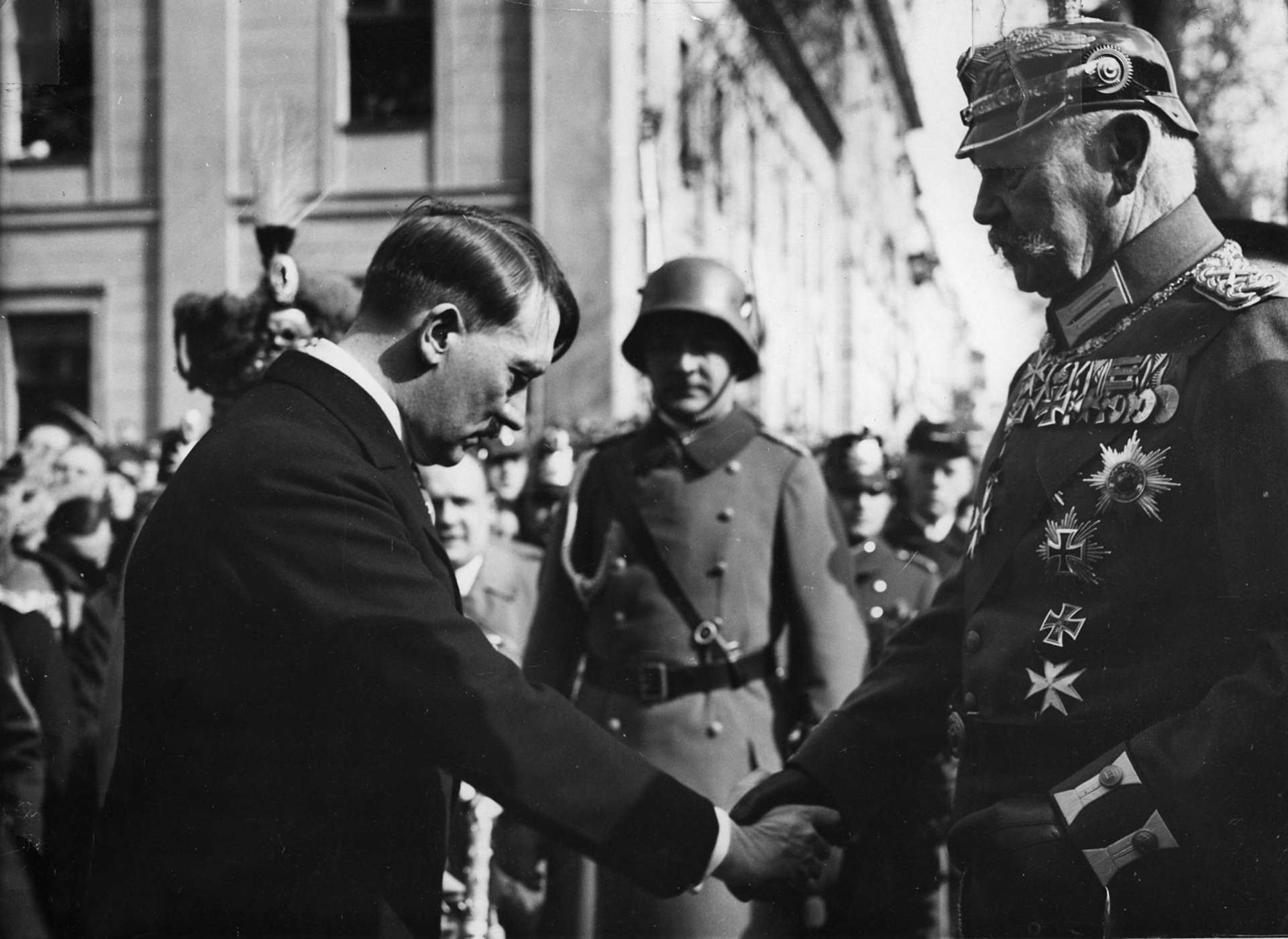
Adolf Hitler and High german President Paul von Hindenburg, shortly after Hindenburg asked Hitler to become chancellor in 1933. (Epitome: Bundesarchiv, Bild 183-S38324.)
-
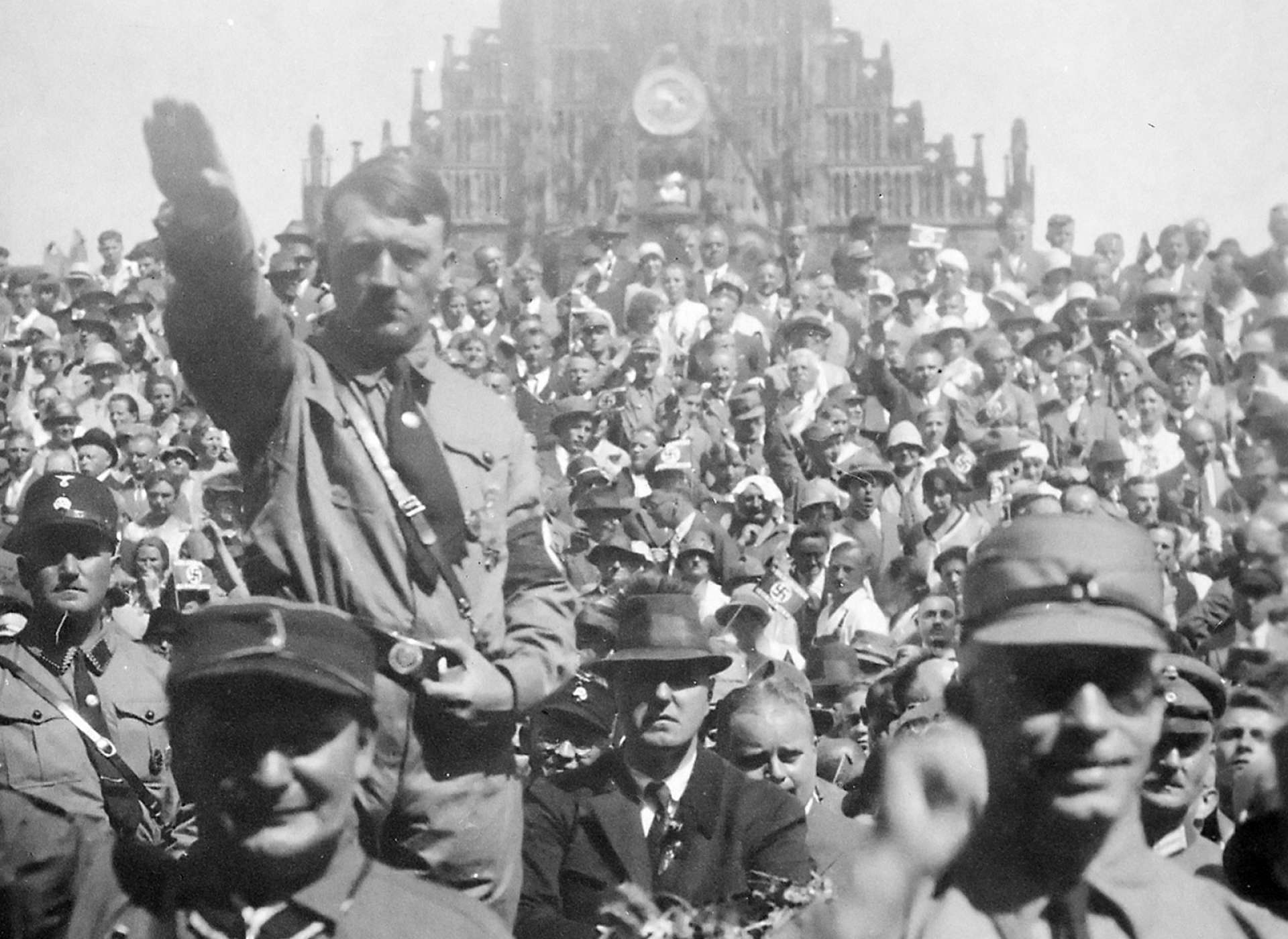
Adolf Hitler giving the Nazi salute at a rally in Nuremburg in 1928. (Image: National Archives and Records Administration, 242-HAP-1928(46).)


By 1932, the Nazis were the largest political party in the Reichstag. In January of the following twelvemonth, with no other leader able to command sufficient support to govern, President Paul von Hindenburg appointed Hitler chancellor of Germany. Before long thereafter, a burn broke out in the Reichstag edifice in Berlin, and government arrested a young Dutch communist who confessed to starting it.
Hitler used this episode to convince President Hindenburg to declare an emergency decree suspending many civil liberties throughout Germany, including freedom of the press, freedom of expression, and the correct to agree public assemblies. The police were authorized to detain citizens without cause, and the authority usually exercised by regional governments became subject to command by Hitler's national regime.
Almost immediately, Hitler began dismantling Frg'south autonomous institutions and imprisoning or murdering his chief opponents. When Hindenburg died the following year, Hitler took the titles of führer, chancellor, and commander in main of the army. He expanded the army tremendously, reintroduced conscription, and began developing a new air force—all violations of the Treaty of Versailles.
Hitler's war machine spending and ambitious public-works programs, including building a German language autobahn, helped restore prosperity. His regime also suppressed the Communist Party and purged his own paramilitary storm troopers, whose violent street demonstrations alienated the German centre class.
This bloodletting—chosen the "Nighttime of the Long Knives"—was hugely popular and welcomed by the middle form as a accident struck for constabulary and guild. In fact, many Germans went forth with the full range of Hitler'due south policies, convinced that they would ultimately exist advantageous for the country.
In 1938, Hitler began his long-promised expansion of national boundaries to incorporate ethnic Germans. He colluded with Austrian Nazis to orchestrate the Anschluss, the annexation of Austria to Federal republic of germany. And in Hitler'due south most brazenly aggressive act notwithstanding, Czechoslovakia was forced to give up the Sudetenland, a mountainous edge region populated predominantly by ethnic Germans.
The Czechs looked to U.k. and France for help, but hoping to avoid war—they had been bled white in World War I—these nations chose a policy of appeasement. At a caucus held at Munich in September 1938, representatives of U.k. and France compelled Czech leaders to sacrifice the Sudetenland in return for Hitler's pledge not to seek boosted territory. The following year, the High german regular army swallowed up the remainder of Czechoslovakia.
British Prime Minister Neville Chamberlain, i of the signers of the Munich pact, had taken Hitler at his word. Returning to Britain with this agreement in hand, he proudly announced that he had achieved "peace with honor. I believe it is peace for our time."
A year later, German troops stormed into Poland.

Like this commodity? Read more in our online classroom.
From the Collection to the Classroom: Teaching History with The National WWII Museum
Larn More
Afterward being released from prison, Hitler vowed to work within the parliamentary system to avoid a repeat of the Beer Hall Putsch setback. In the 1920s, however, the Nazi Political party was nevertheless a fringe group of ultraextremists with little political ability. It received only 2.6 percent of the vote in the Reichstag elections of 1928.
Simply the worldwide economic low and the rising power of labor unions and communists convinced increasing numbers of Germans to turn to the Nazi Party. The Nazis fed on bank failures and unemployment—proof, Hitler said, of the ineffectiveness of autonomous government. Hitler pledged to restore prosperity, create civil order (by crushing industrial strikes and street demonstrations by communists and socialists), eliminate the influence of Jewish financiers, and make the fatherland in one case again a earth power.
Explore Further
-
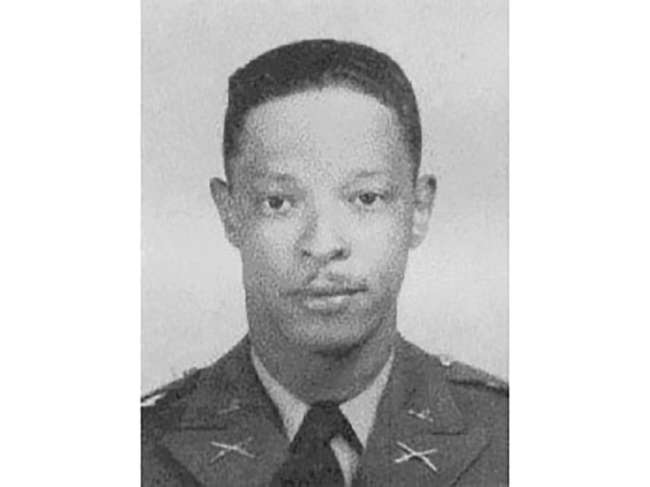
John Fox
John Fox was one of seven African Americans who had their earlier awards upgraded to the Medal of Award on Jan 13, 1997. Like all simply one of the veterans, he did not live to meet this honor.
-
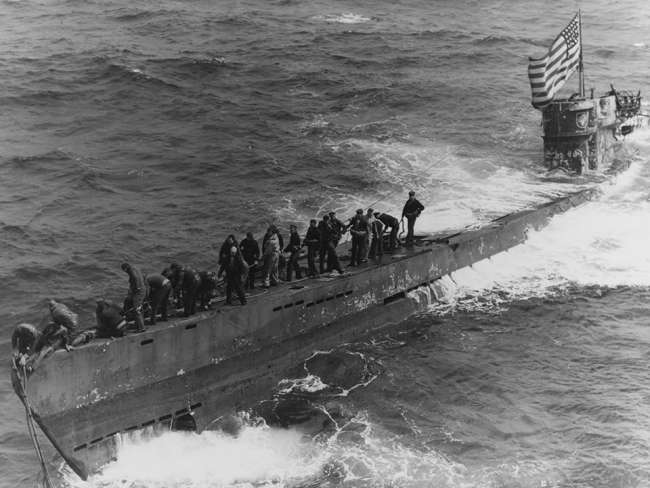
Wolf Beneath the Waves: U-505 Joins the Battle of the Atlantic
For Allied leaders, 1942 was a year of incredible danger and anxiety in the Battle of the Atlantic.
-
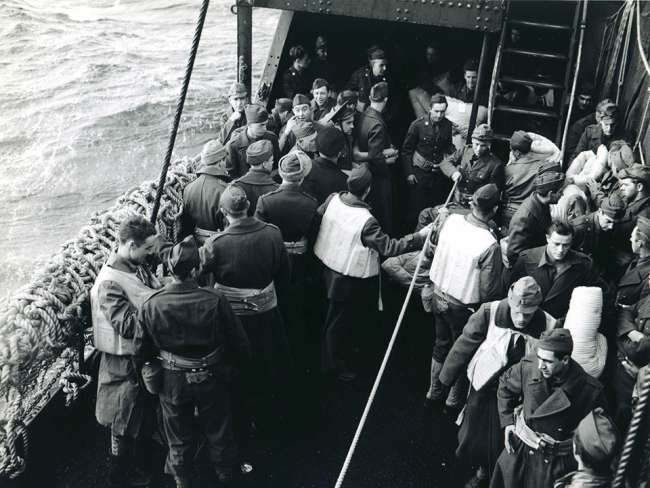
American Soldiers Arrive in the United Kingdom, January 26, 1942
Soldiers of the US Army'southward 34th Infantry Division, the "Ruby-red Balderdash" Sectionalization, landed in Belfast, Northern Ireland on January 26, 1942.
-
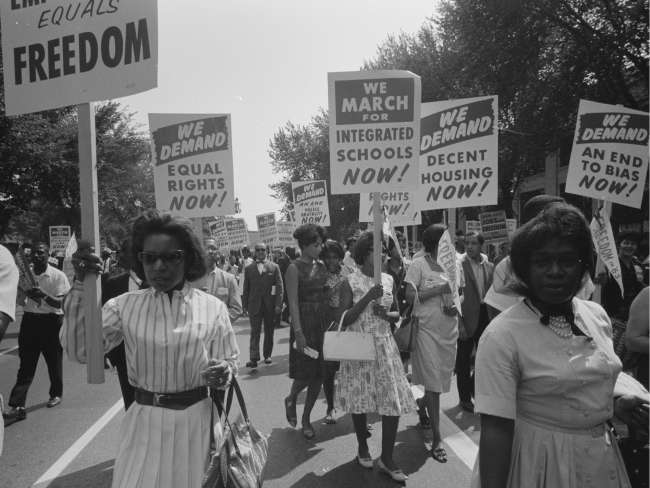
Tension in a Peacetime Gild
The experiences of those left to support the war effort on the Habitation Front, combined with those of returning veterans, helped further reveal underlying tensions and led to significant changes in the social history of the United States.
-
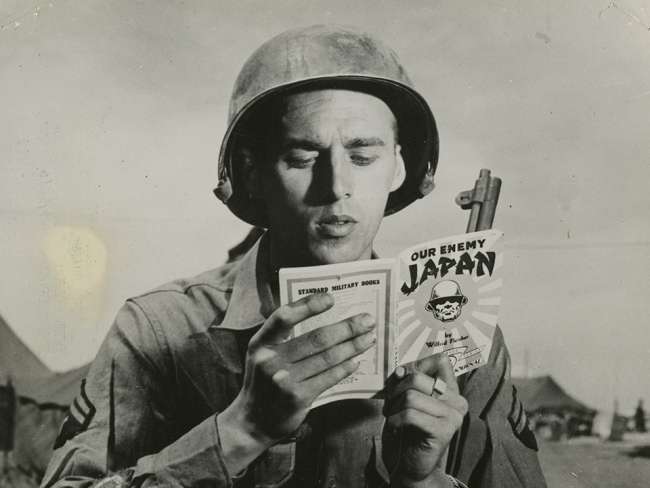
x Notable World War 2 Books of 2022
Must-reads of 2022 picked past historians and scholars in the Institute for the Study of State of war and Democracy.
-
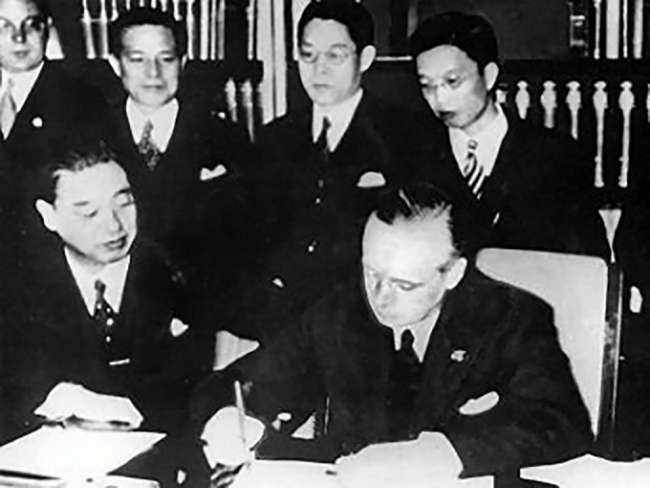
Nazi Germany, Imperial Nihon, and the Anti-Comintern Pact
The signing of the Anti-Comintern Pact between Germany and Japan in 1936 was one of the truly momentous and horrifying conjunctures of the twentieth century.
-
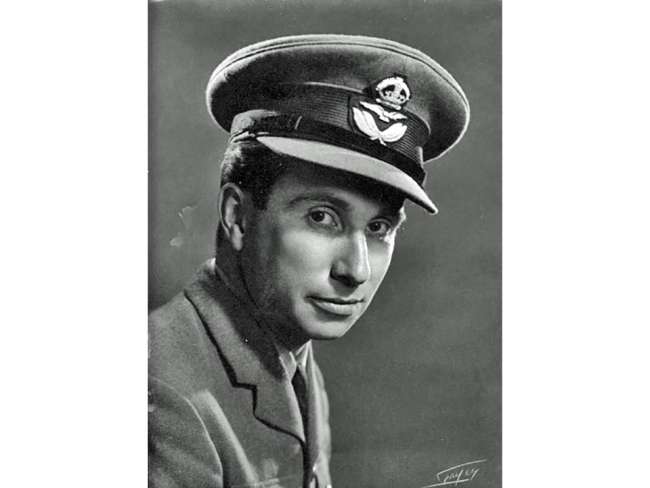
American Baton Fiske—One of the Few
Pilot Officer Baton Fiske was the starting time US citizen to travel to the United Kingdom at the onset of World State of war 2 to bring together the Imperial Air Force, and was one of seven American pilots to take part in the Boxing of Britain.
-
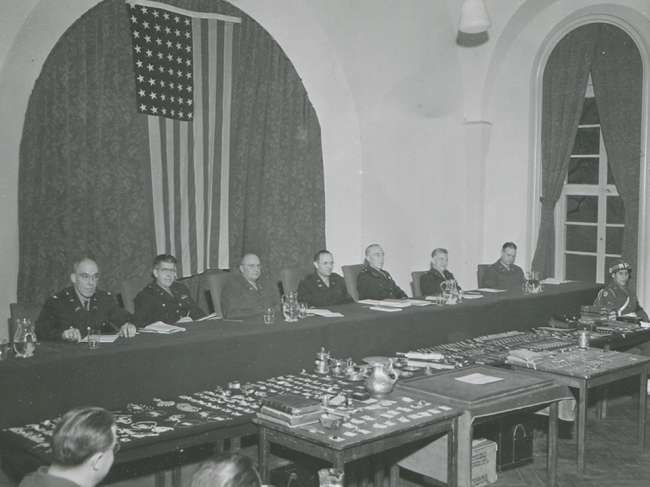
The Hesse Heist: The Accused Are Tried
The final installment of the story of the Hesse Heist covers the trials of Nash, Durant, and Watson.



Source: https://www.nationalww2museum.org/war/articles/how-did-hitler-happen
Posted by: rutledgepaus1952.blogspot.com
0 Response to "Which Events Helped Draw People To Support Adolf Hitler's Nazi Party?"
Post a Comment