

How To Draw Roads In Sketchup
Update: March 2015
For a re-create of the plugin delight see this link (apply download link in top right, please do not enquire for edit access) as the original owner appears to have moved the site. This version has been updated to work with the newer versions of sketchup. If you lot take trouble with this copy on older sketchup versions then attempt the original file which can be constitute here. Just copy the plugin to your Sketchup plugins directory Eg: C:\Program Files (x86)\Google\Google SketchUp 8\Plugins or run into here for newer sketchup versions). Restart sketchup and so access it from the "Depict" card.
—————————————
The following is a guide for designing gears in sketchup for 3D printing, CNC milling or similar. For a skillful introduction in general gear design see here. For an introduction to sketchup see the sketchup related links this page.
A collection of the gears seen in this folio tin can be downloaded from the 3d warehouse.
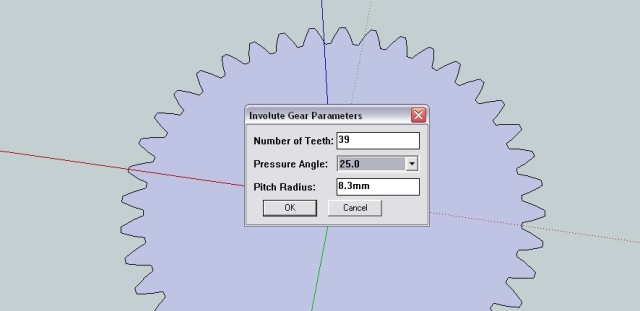
To begin with, download the involute gear plugin and copy it to your sketchup plugin directory. This plug-in was not produced by me and all credit goes to Cadalog Inc for writing this very useful tool. Then open up sketchup and choose 'Involute Gear' from the draw bill of fare. From the dialogue box y'all are presented with three options.
-
Number of Teeth.
The number of teeth on your modest gear (pinion gear) relative to your big gear (gear wheel) will determine the gear ratio. If y'all desire a gear ratio of two:i then your gear wheel volition have twice as many teeth every bit your pinion. Nevertheless, your gear with more than teeth would need need to be twice the size in order to have the same sized teeth.
Past choosing an even number of teeth you have a range of different verbal gear ratios. For case; 12 and 24 (i:2), 12 and 36 (ane:iii), 12 and 48 (ane:4) ect. However, an fifty-fifty number of teeth volition event in the aforementioned pair of teeth meeting over and over again. By having an odd number of teeth each tooth will meet a unlike counterpart on every rotation. This helps to distribute lubricant and reduce ware. For example, Wade's geared extruder has 11 teeth on the pinion and 39 teeth on the gear wheel.
Try and select the highest number of teeth possible while still maintaining a printable resolution. Have no less than 12 teeth and try to avoid a gear ratio any college than one:6.
-
Force per unit area Angle.
The pressure angle furnishings the geometry of the gear teeth. A depression pressure angle (fourteen.5) is normally used with loftier number of teeth (40+) and will give a greater contact area but atomic number 82 to increased noise and backlash. Source. I would recomend sticking to a pressure bending of 20. What ever pressure angle yous choose, make sure it is constant among all gears used together.
-
Pitch Radius.
This is not the outermost radius of the gear (the root circumvolve). The pitch radius is the distance from the middle of the gear to the 'pitch bespeak', the point of contact between the two gears.
As such, the outermost radius of the gear for a fixed pitch radius volition modify for different numbers of teeth. However, no matter the number of teeth, the 'pitch point' will remain constant for all gears.
The fundamental signal here is that if you desire two gears to mesh well, and then the pitch radius must be increase or decreased by the same ratio as your number of teeth. For example, lets say you have a small gear with 10 teeth and a pitch radius of 10mm. If you wanted a ratio of i:3 then your large gear would demand thirty teeth and pitch ratio of 30mm.
One time you lot are comfortable with these settings its quite unproblematic to make a range of different gears. When you have finalised your gear design y'all tin can consign the file every bit an STL.
Anfractuous Gear
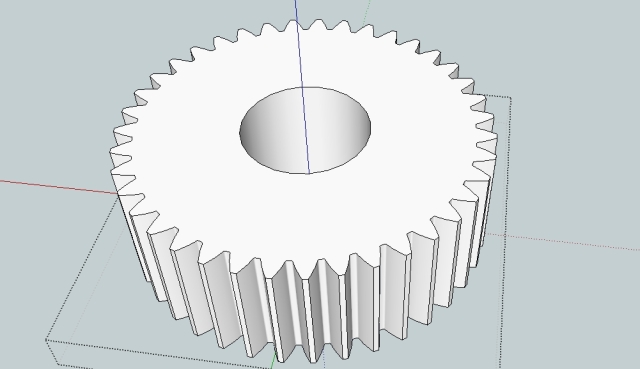
To create an involute gear, use the plugin every bit described to a higher place to outset create the gear outline. The gear outline will appear at the point 0,0 so its good idea to mark the centre position earlier moving it. Add your heart shaft hole and and then use the Button/Pull tool (hot cardinal 'P') to make the object 3d.
Helical Gear
Make sure the heart of your gear is nonetheless positioned at the betoken 0.0. To create a helical gear simply follow the aforementioned process as for the anfractuous gear but with ane extra step.
After you lot have 'pulled' your gear surface up to brand it 3d, select simply the meridian face of the gear and choose the rotate tool (hot cardinal 'Q'). With the top confront nonetheless selected position the protractor over at the centre of the gear and right click. If y'all have an empty space for a shaft in the centre then just hold downwardly shift while hovering the protractor over a horizontal expanse to lock it in that orientation. So its but a affair of choosing your desired angle. For a single helical gear the angle used is normally 6,eight,ten,12,fifteen,xx degrees. Be aware that a greater angle will result in a greater axial load (see below).
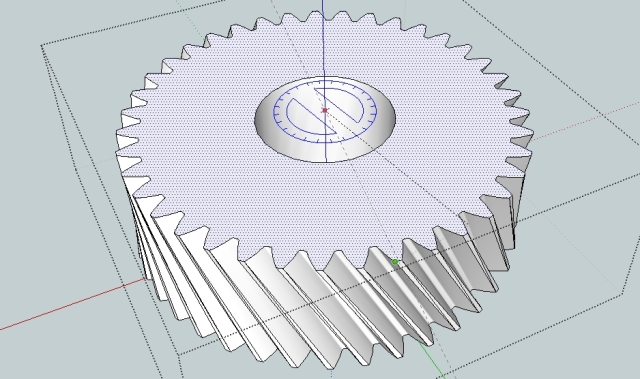 Why would yous utilise a helical gear? They tin reduce backfire, ware and racket equally opposed to an anfractuous gear. This is due to the gears meshing slowly over their length rather than all at once. However a single helical gear will result in a centric (in the management of the shaft) load. This tin be overcome by using a double helical (herringbone) gear as seen below.
Herringbone Gear (double Helical)
To make a herring bone gear follow the same processes as for the helical gear. Due to elimination of axial loading (meet beneath) higher helical angles can be used. Eg 25,30,35,40 degrees. Select the pinnacle face up of the helical gear and pull it up so that your gear is now double in height. And so use the rotate tool to rotate information technology dorsum in the opposite direction as the lower half.
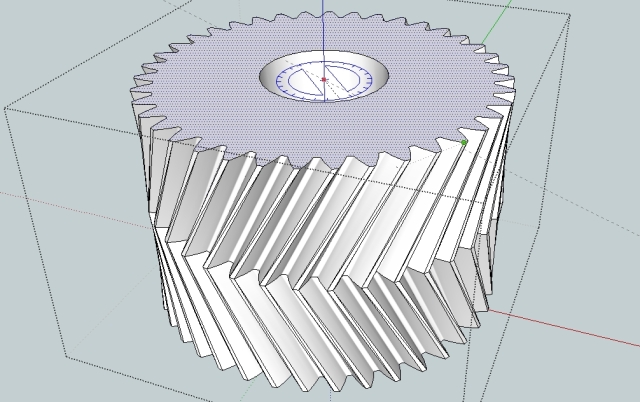 The advantage of the herringbone gear is that all axial forces are cancelled by the opposing helices. This allows for all the advantages of a helix gear with out any of the disadvantages. A herringbone gear will also self center. Delight note that if two herringbone gears are even slightly miss aligned and then stock-still in identify then they will damage each other. Its best to first fix i gear in place on its shaft while leaving the other free to motility parallel to its own shaft. So turn the fixed gear's shaft and allow the second gear to 'self align' earlier finally fixing the second gear in place on its shaft.
More information about double helix (herringbone) gears tin be found here and here.
Straight Bevel Gear
To produce a straight bevel brand sure you add the shaft hole subsequently making the bevel or else the shaft the incorrect shape. Follow the same steps as for the involute gear then select the peak face only. Choose the scale tool (hot key 'S') and while holding down Ctrl (to scale into the centre) select an outside corner and reduce the summit face in size. You lot volition discover that as you do this you change the bending of the gear teeth.
The angle of the gear teeth is important. You can choose any bending so-long as the matching gear has a respective angle that together they make up 45 degrees. For example, if the teeth on one gear are at 10 degrees off the vertical then the second gear will need to take teeth that are 35 degrees off their original position.
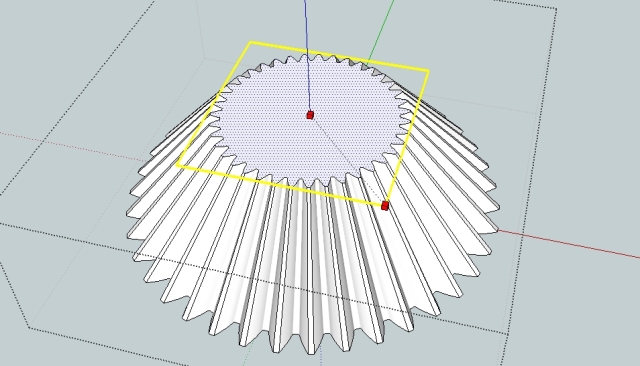 By producing 2 bevel gears yous can transfer mechanical power over 90 degrees. Bevel gears can also be used to change gear ratios. The possible combinations of size and shape are endless then its best just to take a play around in sketchup to get used to information technology.
Internal and Planetary (Epicyclic) Gears
The involute gear plugin can also be used for creating internal gears and planetary gears. To create the external gear, start select the circle tool and starting from the origin drag it out to your desired size. This is your external gear. Adjacent, using the involute gear plugin produce a gear with the exact dimensions you lot desire for the inward facing teeth of your external gear. This will also appear at the origin. Using the pull tool, make the new gear you simply created into a 3D object of whatever height.
The side by side step is the important ane, select the gear 'grouping' (one click on the gear instead of two) and then right click and from the menu choose Intersect -> Intersect with model. There will be a curt interruption. Once washed you tin can delete the gear grouping entirely and y'all will be left with your original circle with the outline of the gear 'intersected' into it. From this you can delete the centre face and pull up the outer face to give you your external gear. This tin can then be populated with other gears to make a planetary gear system or similar.

Y'all tin find a collecting of all these gears in 1 model here. If you have whatsoever suggestions, comments or corrections and then by all means get out a comment.

Source: https://capolight.wordpress.com/2011/01/22/drawing-gears-in-sketchup/
Posted by: rutledgepaus1952.blogspot.com
0 Response to "How To Draw Roads In Sketchup"
Post a Comment